Tag: seo

  • Things we learned from Google AI search – Change for advertisers

    Things we learned from Google AI search – Change for advertisers

    Google’s new AI search might mean a big change in the way advertisers and Ad agencies work with search.

    Recently in the UK, we have seen the introduction of Google AI search. Whilst many in the digital space may have already moved on from the normal Google Search query and use tools like Claude or Perplexity instead, one of the ways to get the masses across to AI is surely for it to be incorporated into AI search.

    It is therefore important we understand Google AI search, and what its introduction will mean for the way consumers search.

    Recently speaking on the Modern Wisdom YouTube channel, Rory Sutherland, Vice Chairman of Ogilvy Advertising spoke about how search is changing. He made the point that historically, businesses have needed ads agencies to attract consumers, but now with AI, we might see consumers using AI as essentially an ads agency, to find their business.

    This is an interesting point made at an interesting time, as it ties in completely with some of the initial findings from some basic Google AI search prompts.

    What we learned from Google’s AI search

    When looking at service-led businesses in large cities, such as a physiotherapist in London, we saw Google giving tips on which sort of business to choose. At the bottom of the search result, there were suggestions identifying the following things as good indicators of what made the ‘best physiotherapy practice in London.’

    Does this give away some of the key considerations Google look at when deciding what search results to show you for ‘best physiotherapist London’?

    It certainly looks that way, and whilst the digital world knows largely the EEAT signals and how to show Google you are trustworthy, some of the considerations above are interesting, and shows Google’s workings almost saying to the consumer, these are the things we value and you should too.

    Considerations in search

    See below another example for opticians, similarly, considerations of what to look out for when choosing your service led business are again listed.

    Interestingly here, Google AI search gives the added breakdown of benefits for choosing an independent Opticians, or a chain, considering price and how personalised the experience is.

    This is very important as it highlights if you are an independent local Optician, you need to draw into what makes your business unique so that you can stand out from competition and identify to Google you are a good choice for those searching for independent Opticians.

    Recommending how you should proceed

    Within the search for an Optician, there was also some direction from Google on how you should proceed:
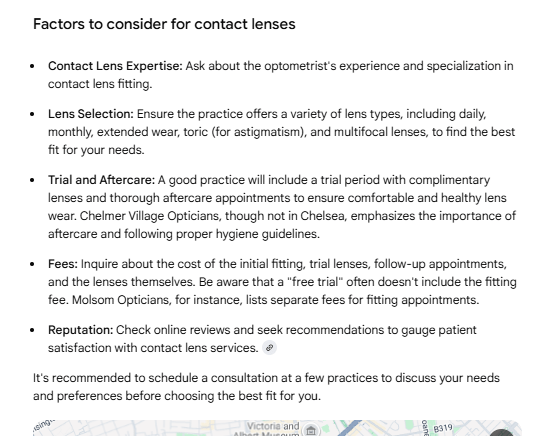
    See at the bottom of the above image “It is recommended to schedule a consultation for a few practices.”

    Here Google show that they do not believe one best practice is the best for everyone, which may indicate why there is a wide range of variation of local service business search. Google works hard to tailor your needs the best, then recommends contacting a few of its suggestions to find the best fit.

    If you are in one of these businesses, trying to get customers, this is where you front-of-house approach is really key. Being the first to answer the phone or contact a customer is so important and also addressing their needs quickly and effectively will be sure to capture that lead.

  • Google Ads search term research

    Google Ads search term research

    Testing over 400,000 search terms to establish key trends in what drives conversions, high CTR and clicks in Google Ads.

    Taking data from the last six months from Google Ads search campaigns that aim to drive phone calls and form fills from a landing page for a service led industry.

    These search terms come from over 75 campaigns, spending small individual daily budgets to promote local services to individual locations. A lot of the data analysed made a lot of sense but still made for interesting reading.

    Highest converting keywords

    The top 50 converting keywords all contained the exact service name within them, usually followed by a location term. EG service:London.

    Of the top 50 converting keywords, 48 were from exact or phrase match keyword types. General consensus from looking at all of these search terms were that broad match were the least valuable.

    Note: We straight away could identify from this data that broad match keyword types were good for getting ads out there and keyword suggestions in, but they become redundant very quickly and for small budget, service campaigns, exact and phrase match brings in the conversion data.

    Eight of the top ten performing keywords for conversions were exact match.

    Highest CVR search terms

    Just looking at top ten highest performing CVR, of those search terms that got any conversions, six included location terms, two of ten were actual rival brand search terms.

    If no Google Ads are running for those rival brands, you could argue adding those search terms into your keyword list could have benefit, but with small daily budgets, its hard to commit to effectively bidding on customers that may already have interest in your rival brand and may just be searching for them.

    Highest impressions

    Highest impressions are not always a good measure of a search terms effectiveness. So tread with caution. One thing to note, 48 of the top 50 highest impression search terms contained the service name, in fact 95% of the top 100 search terms that had conversion data contained the service name, emphasising the importance of service inclusion within all keywords.

    Excluded search terms

    Many of the search terms analysed had been excluded at a campaign level. Of these keywords, eight of the top ten were broad match, so the opposite of the high conversion search terms. Some of the excluded terms did have very high conversion numbers, but the low quality broad search terms would have undoubtedly led to low quality leads further down the funnel.

    Five of the top ten excluded search terms included free services, for example ‘private doctor’ ad groups receiving search terms like ‘nhs doctor’

    This was probably more emphasis of some campaigns being in their infancy and not already having these search terms excluded.

    Google Ad search term tips:

    Overall, the key to success for these service lead search campaigns were including the service within the keyword at all costs. For example “chemist near me” “chemist with GP”, “New chemist open” etc.

    Broad match keywords are not effective for high quality conversions. They can be important for building out a campaign and finding keywords if you are stuck for ideas in max clicks.

    They should go no further than the first or second round of optimisation and should not feature when moving to max conversions.

  • How to write effective Google Ads copy

    How to write effective Google Ads copy

    Engaging Ad copy which which speaks too and informs the user is very effective. It helps you to stand out among all other boring ad copy.

    There are a number of factors which can be used to improve your Google Ad copy, from alterations to the headlines, to the descriptions of the ads and providing as much information as possible to make your ads stand out. Find some best practice guidelines for creating strong Ad copy below.

    black samsung tablet on google page

    Keyword focus

    Your headlines do need to have a keyword focus to improve CTR as people literally see what they are searching for so are more likely to click it. Google also used keyword focus in their Ad Quality scores.

    Brand mention

    You should also aim to include a brand mention, don’t waste the opportunity to get the brand name in headlines to get the word our and let the world know who you are. They may recall the brand name if they search again.

    Strong call to action

    You need a strong call to action, to do this you need to think about what you want them to do and what benefit they will get if they do that. It is almost like giving your searcher a clear instruction, and it’s a chance to introduce a searcher to what you want them to do before they have even reached your website.

    Then you have prepared them for the messaging they will see on the website, that repeatability is good for a user as it supports continuity and provides them with comfort and guides them towards completing the action you want by reinforcing it in a searchers mind.

    photo of a laptop screen with google main page on it

    Repeatability in copy can encourage people to remember and share your brand or copy. If they have a positive experience and can remember your copy, for example ‘who did that? George Did it, did it,’ then that is something that sticks to the brain (maybe not the best example think more Nike Just do it or McDonalds I’m lovin it’) they can easily remember that and say to others oh I got that from Nike or have you tried this at McDonalds.

    This works great in all copy but why not extend it to ad copy too. Repeatability can convert users into your own salespeople. Find out more here.

    Emotional triggers

    If your messaging can provide that emotional trigger which matches up to why someone may be searching for your product or service, then they are more likely to click on your ad. You’re trying to introduce a feeling that they can’t not choose you, trying to talk to the searchers pain or need, what is the pain they are feeling and what is the solution that you can provide them which they now can’t ignore.

    Your keyword focus is key for Google, but CTA, and emotional triggers are very important for what users like. You want to make sure that Google will like your ads, but you’re trying to appeal to your user, so include triggers and CTA’s that will help your users. Depending on your business you can experiment with varying levels.

    Not only do you need emotionally engaging copy, with strong CTA’s and offers, but you also need the knowledge and understanding to test various Google Ads and the copy to come up with the best solution.

  • Creating digital content in 2025

    Creating digital content in 2025

    Creating digital content requires the combination of many things. The primary factor should always be keeping your user in mind. Below you can find some simple tips to help you create engaging, high quality digital content.

    person writing on a notebook beside macbook

    Simple guide to creating good digital content

    1. Keyword Research:

    • Identify relevant keywords related to your content using tools like Google Keyword Planner, SEMrush, or Ahrefs.
    • Choose a primary keyword and a few secondary keywords for each piece of content.

    2. Understand User Intent:

    • Determine the user’s intent behind the search query that will get them to your digital content. Is the user looking for information, a product, a solution to a problem, or something else?

    3. Content Structure:

    • Organise your content into a clear and logical structure. Use headings (H1, H2, H3) to break down the content into sections.
    • Incorporate bullet points, numbered lists, and other formatting to enhance readability.
    notebook

    4. Quality Content:

    • Create high-quality, valuable, and engaging content. Google rewards content that provides a positive user experience.
    • Address the user’s query comprehensively and include relevant details.
    • Find a full guide on creating high quality content here.

    5. Mobile Optimisation:

    • Ensure that your content is mobile-friendly. Google prioritises mobile-friendly websites in its search rankings.
    • Test your content on various devices to ensure a seamless user experience.

    6. Social Media Integration:

    • Share your content on social media platforms to increase visibility and drive traffic.
    • Encourage social sharing by including social media buttons on your website.
    close up photography of smartphone icons

    7. Regular Updates:

    • Keep your content up-to-date. Search engines prefer fresh and relevant content.
    • Update and republish older content to reflect any changes or new information.

    8. User Engagement:

    • Encourage user engagement through comments, social shares, and other interactive features.
    • Respond to comments and engage with your audience to build a community around your content.

    By following these steps, you’ll be able to create digital content that not only appeals to search engines but also provides value to your audience. Remember that the key is to strike a balance between optimisation and user experience.

  • Landing pages for lead generation

    Landing pages for lead generation

    Landing pages for lead generation aim to be a minimally invasive, less distracting single page web layout. They have the aim of capturing personal information like names, email addresses or phone numbers to move a prospective client / customer into the next part of the marketing funnel.

    Lead generation is a vital part of digital marketing for a number of sectors and for many is one of the sole ways of generating customers. Many smaller businesses fail to capitalize on this and create complex landing pages that have very little optimisation for lead generation.

    The best landing pages are simple, emotive, and put all their efforts into getting what they need from the user. Below are some good landing page examples encouraging lead generation.

    1. Branch furniture

    There are so many elements that make this landing page effective. Such as:

    • Colour scheme
    • Rule of three listing
    • Consistent CTA’s
    • The ‘why choose us’

    Colour scheme

    The colour scheme is effective because of the use of light and dark colours to highlight different things. The dark calls to action, in the same colours provide familiarity to users, and that darker colour stands out against the light, to draw attention and say click me.

    Reuse of the darker colours in the full width banner is also important, because that banner highlights brands the company has worked with, in an attempt to build trust. Making the darker colour the trustworthy colour, meaning the CTA’s are similar. Evoking that ‘trust us you can click me.’

    Rule of three listing

    The next key element is the rule of three list under the heading. These bullet points highlight three key features of this brand, laying out the brands wares straight away. This is again in an effort to build trust, and to show expertise. The three ticks instead of bullet points also evoke that these are positive benefits associated with this brand.

    Consistent CTA’s

    A very simple feature, but effective. ‘Build my office’ uses exactly the emotive language to get you the viewer started. You feel like you are making progress because of the verb build, and it has the personal touch of my office. By clicking this button you will actually just be entering an email address or phone number, not building an office, but building is the goal so you feel you are making that progress towards building that office.

    The why choose us

    In this instance the ‘why choose us’ is listed as ‘The Branch Difference.’ This emphasises the differentiation between this brand and others which offer the same services. This is done just near the fold as if to say, if you aren’t convinced yet take a look at this and this could tip you to converting. Four clear points with diagrams give nice explanations as to what the brand is all about.

    2. Salesforce

    Strong parts of the salesforce landing page:

    • Form above the fold
    • Rule of three
    • Build trust with reviews

    Form above the fold

    A simple technique, take away the users need to scroll. UX research will tell us that fewer people make it to the bottom of a landing page than view the top, so make sure you have a hierarchy of information established, make things easy for your users and give them that contact form straight away. The biggest challenge for this is landing pages for mobile devices, that is where the call to action down to a form is crucial, or if effective, lead with your form and get people in straight away.

    Rule of three

    Again within this landing page for lead generation we see a very simple rule of three. Almost listed as a ‘this is what we’ll do for you.’ Simple sentence structure to say what it does on the tin so to speak.

    Build trust with reviews

    If you have solved a problem for another client or customer the chances are they’ll have something nice to say. Get them to write that down and get that endorsement onto your landing page to show future users that you are reliable.

    3. Blue forest farms

    What stands out on the Blue forest farms landing page:

    • Simple sentencing
    • Taking the user on a journey
    • Options to convert

    Simple sentencing

    The user is going to be looking for your page with a solution in mind, tell them your solution nice and simply and straight away. This landing page does that with some basic paragraph copy at the top of the page with no other distractions or bells and whistles. Just simple sentencing then a call to action if you’re interested.

    Take the user on the journey

    The use of a timeline is incredibly effective as it takes your eyes down the page and on the journey of the product. The main points are highlighted, but you are telling a story at the same time, building trust, showing your expertize and highlighting what can be expected. A great way to build engagement and encourage people to click those consistent CTA’s.

    Options to convert

    Every stage of the timeline gives you the option to click to convert. This is effective because less people will get further down the page, if you find the info you need you can very quickly click and convert. However if you need more info it’s their for you, the CTA’s provide the break ups to stop and convert whenever you want too.

    Keep it simple, prioritize information and you’ll convert

    The overarching features of all of these landing pages are simplicity around messaging and journeys. Providing users just the right info they need then multiple conversion points through forms and calls to actions. There is no need to over-complicate a landing page. Get your user in and converted as soon as you can.