Category: Health and well-being

Simple teachings on how to maintain a healthy lifestyle

  • Things we learned from DOAC Buddhist Teacher

    Things we learned from DOAC Buddhist Teacher

    The Diary Of A CEO was joined by Buddhist teacher Gelong Thubten who discussed the importance of meditation to support your health and well-being.

    Thubten is one of the UK’s most influential meditation teachers and he spoke on the importance of meditation to help manage stress, anxiety, depression and poor mental health.

    Below are they key things we learned on meditation from a Buddhist teacher.

    1. We are materially more comfortable now than ever, but emotionally the most uncomfortable we have ever been

    In our existence as humans, we have never been more materially rich than we are now, but it appears to be coming at a cost. Consumerism is driving our false happiness, and we are losing real control of what makes us happy, and that is the freedom from wanting.

    Commonly we now tell ourselves, “we will be happy if…” and “we will be happy when this happens or that happens…” The truth is that our happiness comes from within us and does not directly correlate to what we have.

    Have you ever wanted something so much and when you have got it, that feeling of wanting it immediately disappears. The internal happiness will actually come from being free of wanting anything.

    2. The past and future are an illusion

    If we and everything around us are made from particles, key word being “part,” we can’t exist singularly, everything that defines our being is part of something, and that something is changing every minute of every day. Our cells regenerate so quickly that we are never the same person.

    If that happens to every particle in the universe, then there is in theory no such thing as the past, or the future, we are always existing in the very present moment with the current cells and particles we have, the past no longer exists, the future never existed. We must therefore try to remain present in every moment to deal with the here and now.

    3. Daily meditation can change your life

    Focus on your breath, lose yourself in thought, and gently bring yourself back to your breath. Do this for 10 minutes every day as a start to understanding meditation.

    Meditation is all in the losing yourself and coming back. If you sit and meditate, you have no conscious thought over what takes you away from focusing on your breath. If you bring yourself back from your thought, you are consciously choosing to come back and focus on your breath. That is where their is value in meditation, taking back control of your mind to think about your breath.

    People often think breaking out and being calm and rational might mean you are taking your eye off things or losing focus, but it is done intentionally so you can return with a sharper mind.

    Aim to be the sky instead of the clouds.
  • Morning Rituals to Reduce Stress and Anxiety

    Morning Rituals to Reduce Stress and Anxiety

    If you are working in a highly stressful job, or are prone to feeling anxious or worried, your symptoms can be affected by high cortisol levels.

    A simple, morning routine can lower cortisol levels and help you maintain a mentally healthy, balanced lifestlye.

    The simple morning routine you can adapt to suit your lifestyle

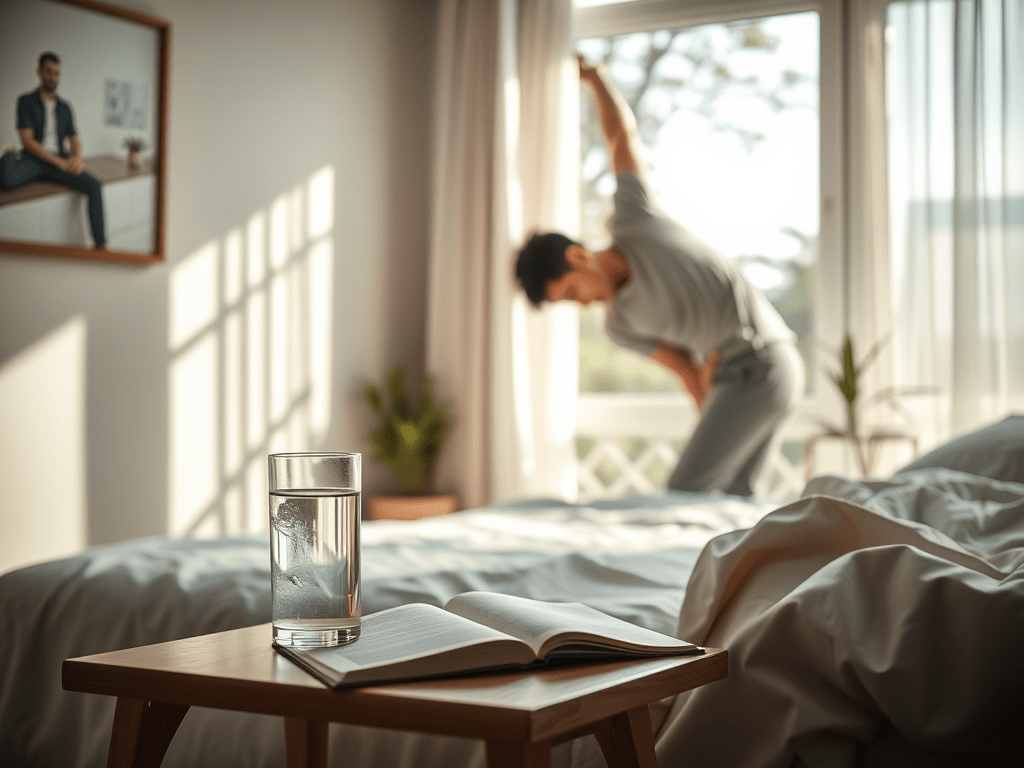
    Wake up naturally – Either use a soft alarm or wake up with no alarm, no brisk alarm which will make you jump / shock you.

    Hydrate – Before you look at your phone / get on with your day, drink a glass of water to help wake up your digestive system. Try to avoid caffeine for at least 90 minutes after you wake up

    Stretch – Get up and get mobile, stretch, breathe and practice mindfulness techniques. Do whatever that means to you, focus on your breathing, or focus on your five senses. You can even do this as you stand in the shower.

    Before you leave the shower you can also stand under a cold shower for 30 seconds, this can support your dopamine levels and standing under the cold water can be challenging and therefore completing that quick morning challenge can be very rewarding.

    Sunlight – Aim to get up and outside within 30 minutes of waking up. Go for a walk or just stand in natural light and also use this time for mindful thinking.

    Journal – Write a journal entry or write out the plan for your day, if you are working you could write down a couple of things you’d like to progress with in that day, or do the same thing for one of your hobbies.

    If stress is heightened by your job you can…

    Aim to create a separation between your work and your leisure time. If you commute, use your commute to either prepare for the day ahead, with mindful thinking, or on your way home use it to decompress and stop thinking about work. Make sure you have clothes specifically for work and as soon as you get home, change out of them to signify a shift in thought.

    If you work from home, create a pre-work commute, go for a short walk or do simple chores to prepare yourself, again wear separate clothes and change out of them at the end of the working day. Also before you finish work you can write down any stresses or challenges you may have had on that day, to get them out of your head and onto paper.

    Overall you need to simplify your day as much as you can, and allow yourself to be present as often as possible, thinking in the now, not reflecting on the past or worrying about the future.